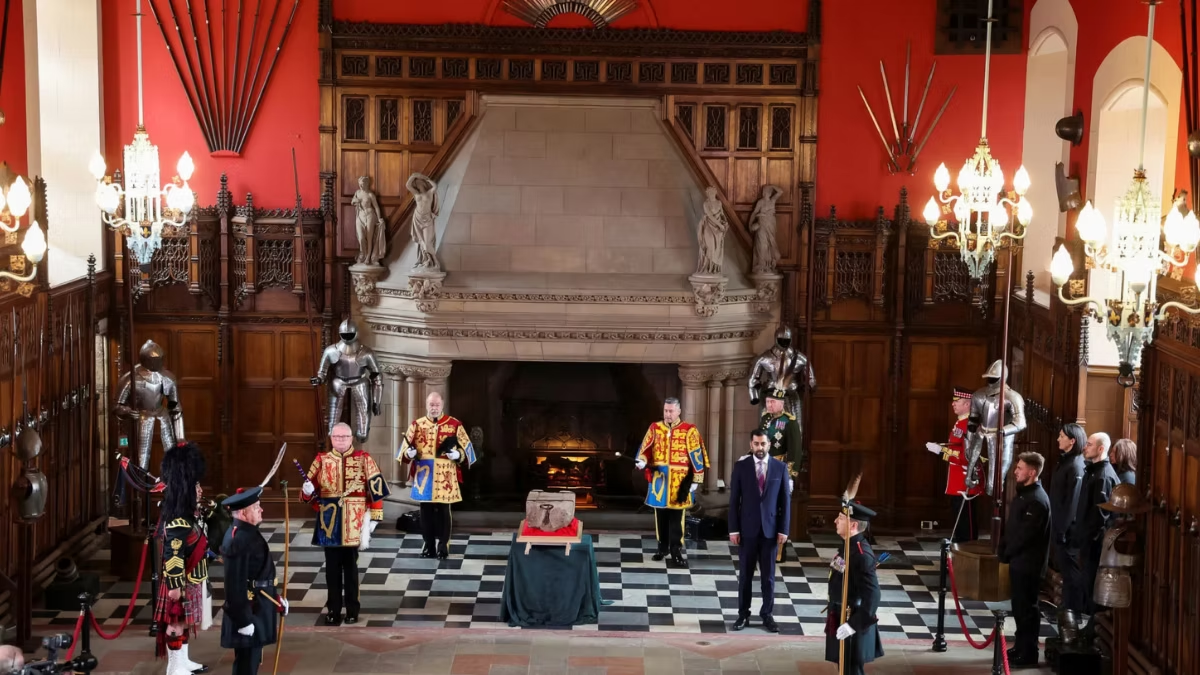
The Stone of Destiny is no longer at Edinburgh Castle. If you’re planning a visit to the Crown Room expecting to see the ancient coronation stone of Scottish kings, you need to know — it moved to Perth Museum in 2024.
But the Stone’s connection to Edinburgh Castle runs deep. It sat in the Crown Room alongside the Honours of Scotland for nearly three decades, and its history is one of Scotland’s most dramatic stories: a medieval theft by an English king, 700 years of captivity, a Christmas Day heist by four university students, and a coronation as recently as 2023. Here’s the full story — and where to see the Stone now.
Where is it now? Perth Museum, Perth, Scotland. Free to view (timed tickets at front desk, no online pre-booking needed). About 1 hour from Edinburgh by car or train.
Edinburgh Castle connection: The Stone was displayed in the Crown Room from 1996 to 2024. The Honours of Scotland (Crown Jewels) remain at the castle.
Best way to see what’s still at the castle: A Guided History Tour with Tickets (£37) covers the Honours and the story of the Crown Room.
Where Is the Stone of Destiny Now?
The Stone of Destiny is at Perth Museum in the centre of Perth, about 60 miles north of Edinburgh. The museum opened in March 2024 after a £27 million redevelopment of the city’s historic Edwardian city hall. The Stone is the centrepiece of the museum.
Visiting is free. The Stone of Destiny Experience is an immersive exhibit lasting about 10 minutes, taking you through the Stone’s history before you see it up close. Timed tickets are booked at the front desk on the day of your visit — online pre-booking is no longer required. Photography is not permitted inside the Stone experience. Bag checks are in operation for security. Last admission is 4:40pm Monday to Saturday and 3:40pm on Sunday.
Getting to Perth Museum from Edinburgh
By car: about 1 hour via the M90. By train: Edinburgh Waverley to Perth takes approximately 1 hour 20 minutes, with direct ScotRail services running regularly. Perth Museum is a 15-minute walk from Perth station. If you visit Perth, Scone Palace — the original coronation site where Scottish kings were inaugurated on the Stone — is just a 15-minute drive away.
The Stone Has Moved — The Honours Haven’t
Edinburgh Castle still holds the Honours of Scotland — Britain’s oldest crown jewels. A guided tour brings their story to life.
Book a Guided History Tour (£37) →
The Stone’s Edinburgh Castle Connection
The Stone of Destiny arrived at Edinburgh Castle on St Andrew’s Day, 30 November 1996. It was a moment of national celebration. Around 10,000 people lined the Royal Mile to watch a procession of dignitaries and troops escort the Stone from the Palace of Holyroodhouse to the castle. Prince Andrew, representing the Queen, formally handed over the Royal Warrant transferring the Stone into the castle’s care.
For the next 28 years, the Stone sat in the Crown Room alongside the Honours of Scotland — the Crown, Sceptre, and Sword of State. Together, they formed the most significant collection of Scottish royal treasures anywhere in the world.
In 2019, the Scottish Government launched a public consultation on the Stone’s future: should it remain at Edinburgh Castle or move to a proposed new museum in Perth? In December 2020, the decision was made: the Stone would return to Perthshire, just three miles from Scone, where Scottish kings had been crowned on it for centuries. The move also meant the Stone would be free to view for the first time — Edinburgh Castle charges admission, while Perth Museum does not.
A 700-Year Story: The History of the Stone of Destiny
The Coronation Stone at Scone (9th–13th Centuries)
The Stone of Destiny is a block of red sandstone measuring roughly 26 by 17 by 11 inches and weighing about 152 kilograms. Iron rings at each end were used to carry it. Its origins are uncertain — legends trace it to the Holy Land, to Ireland, or to the Pictish kings of northern Scotland. What’s documented is that by the 9th century, the Stone was at Scone Abbey near Perth, used in the inauguration of Scottish kings. The first recorded use was for the coronation of the seven-year-old Alexander III in 1249.
Seized by Edward I (1296)
When Scotland’s King John Balliol rebelled in 1296, Edward I of England — known as the Hammer of the Scots — marched north and seized the Stone as a symbol of dominance. He had it built into the base of a wooden throne at Westminster Abbey, so that every English monarch crowned there would symbolically sit above Scotland’s coronation stone. That throne, the Coronation Chair, was used at every English and British coronation for the next seven centuries.
There’s a persistent theory that Scone’s monks gave Edward a fake — a decoy stone — and hid the real one. Edward did return to ransack Scone Abbey again in 1298, which some see as evidence he suspected a switch. Whether the stone in Perth Museum today is the original or a medieval substitute remains one of Scotland’s most enduring mysteries.
The Christmas Day Heist (1950)
On Christmas Day 1950, four University of Glasgow students — Ian Hamilton, Gavin Vernon, Kay Matheson, and Alan Stuart — broke into Westminster Abbey in the middle of the night. They planned to bring the Stone of Destiny back to Scotland.
It didn’t go smoothly. The Stone broke in two as they tried to move it, and one piece was left behind in the Abbey while the students fled with the larger section. They later returned for the missing piece. The Stone was hidden in Scotland for several months, repaired by a Glasgow stonemason, and eventually found at Arbroath Abbey — draped in a Scottish saltire — in April 1951. The four students were never prosecuted. The Stone was returned to Westminster.
[IMAGE: Coronation Chair at Westminster Abbey | Alt: Coronation Chair at Westminster Abbey where the Stone of Destiny sat for 700 years | Caption: The Stone sat beneath the Coronation Chair from 1296 to 1996]
Return to Scotland and the Coronation of Charles III
In 1996, the British Government agreed to return the Stone to Scotland — on condition it would travel back to Westminster for future coronations. On 15 November 1996, a team from Historic Scotland collected the Stone from Westminster Abbey in a covert overnight operation that took six hours of careful lifting. Two weeks later, it went on public display at Edinburgh Castle.
The Stone’s most recent journey south came in May 2023, when it was transported to Westminster Abbey for the coronation of King Charles III. Charles was crowned sitting above the Stone, continuing a tradition begun by Edward I over 700 years earlier. After the coronation, the Stone returned to Scotland and moved to Perth Museum in 2024.
Is the Stone of Destiny the Real One?
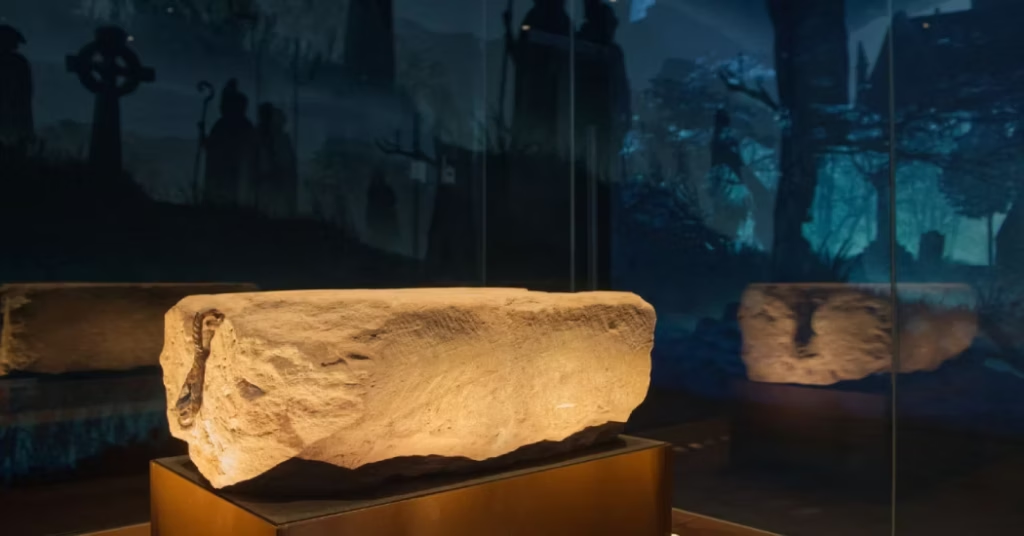
This is the question everyone asks, and the honest answer is: nobody knows for certain.
The theory that Edward I was given a fake in 1296 has circulated for centuries. The Stone looks remarkably plain — VisitScotland describes it as “quite plain and unremarkable in appearance, unlike its colourful history.” Some historical accounts described the coronation stone as ornately carved or resembling a chair, which doesn’t match the current sandstone block. And Edward’s return to ransack Scone in 1298 suggests he may not have been satisfied with what he took.
On the other hand, geological analysis by the British Geological Survey confirmed the Stone is old red sandstone consistent with quarries in the Perthshire area. Testing also proved the stone dates far earlier than the 1950s, debunking the theory that the Glasgow students returned a copy. The Stone is genuinely ancient. Whether it’s the same stone Scottish kings sat on at Scone — that’s the mystery that may never be solved.
What You Can Still See at Edinburgh Castle
The Stone of Destiny may have moved, but Edinburgh Castle’s other treasures haven’t. The Crown Room — the very vault where the Stone sat for 28 years — still holds the Honours of Scotland: the Crown, Sceptre, and Sword of State, dating from the 1490s to 1540. These are the oldest crown jewels in the British Isles, older than England’s by over a century.
The Honours’ own survival story is equally dramatic — smuggled out of a castle under siege, buried in a church floor for nine years, and forgotten in a locked chest for over a century before Sir Walter Scott rediscovered them in 1818.
Beyond the Crown Room, Edinburgh Castle holds the Great Hall, the Royal Palace where Mary Queen of Scots gave birth, St Margaret’s Chapel (Edinburgh’s oldest building), the National War Museum, and panoramic views across the city. For a full rundown, see our Edinburgh Castle highlights guide.
Frequently Asked Questions
Is the Stone of Destiny still at Edinburgh Castle?
No. The Stone was relocated to Perth Museum in 2024, where it is now the centrepiece of a free exhibit. It had been displayed at Edinburgh Castle from 1996 to 2024.
Where is the Stone of Destiny now?
Perth Museum, in Perth city centre. The Stone of Destiny Experience is free. Timed tickets are booked at the front desk on the day of your visit. Perth is about an hour from Edinburgh by car or one hour and twenty minutes by train.
Can you see the Stone of Destiny for free?
Yes. Entry to the Perth Museum and the Stone of Destiny Experience is completely free. You need a timed ticket, which you collect at the museum’s front desk. No online pre-booking is required.
Why was the Stone of Destiny moved from Edinburgh Castle?
Following a 2019 public consultation, the Scottish Government decided to relocate the Stone to Perth Museum, returning it to Perthshire for the first time in over 700 years. Scone, the original coronation site, is just three miles from Perth. The move also made the Stone free to view for the first time.
Is it the real Stone of Destiny?
The authenticity has been debated for centuries. Geological analysis confirms it’s ancient sandstone from the Perthshire area, but whether Scone’s monks gave Edward I a substitute in 1296 remains one of Scotland’s great unsolved mysteries.
Who stole the Stone of Destiny on Christmas Day?
On 25 December 1950, four University of Glasgow students — Ian Hamilton, Gavin Vernon, Kay Matheson, and Alan Stuart — removed the Stone from Westminster Abbey and hid it in Scotland. It was found at Arbroath Abbey four months later. None of the students were prosecuted.
Was the Stone used at the coronation of Charles III?
Yes. The Stone was transported from Edinburgh Castle to Westminster Abbey for the coronation on 6 May 2023. King Charles III was crowned sitting above the Stone in the Coronation Chair, continuing a tradition dating back to 1308. The Stone returned to Scotland afterwards and moved to Perth Museum in 2024.
How do I get from Edinburgh Castle to Perth Museum?
By car, Perth is about an hour north via the M90. By train, Edinburgh Waverley to Perth takes roughly 1 hour 20 minutes on ScotRail. Perth Museum is a 15-minute walk from Perth station. If you’re planning both visits, see our
By car, Perth is about an hour north via the M90. By train, Edinburgh Waverley to Perth takes roughly 1 hour 20 minutes on ScotRail. Perth Museum is a 15-minute walk from Perth station. If you’re planning your castle visit, see our plan your visit guide for transport details and timing.
Two Treasures, Two Cities
The Stone of Destiny’s journey isn’t over. After 700 years at Westminster, 28 years at Edinburgh Castle, and now a new home in Perth, it continues to draw visitors who want to see the stone that crowned Scotland’s kings — and England’s.
If you’re visiting Edinburgh Castle, you won’t see the Stone. But you will see the Honours of Scotland — Britain’s oldest crown jewels, with their own extraordinary story of survival. Between the two, you’ll have seen the objects that made Scottish monarchs for over 500 years.
