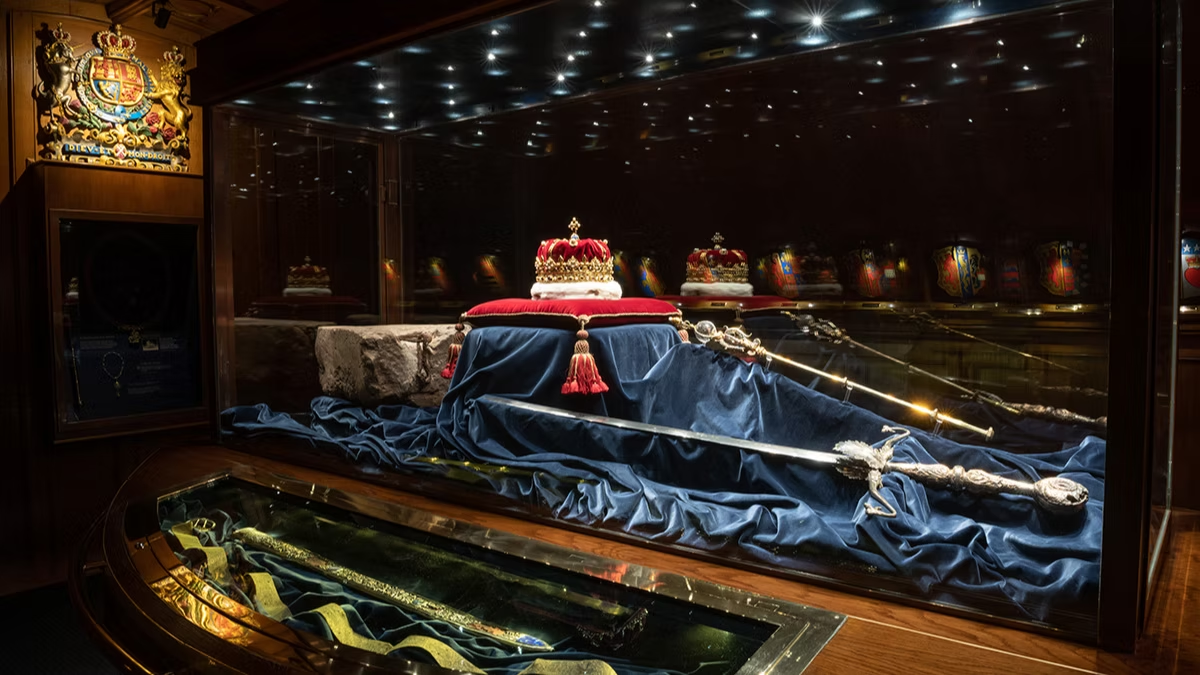
England’s Crown Jewels are reproductions. The originals were melted down by Oliver Cromwell in 1649, turned into coins, and lost forever. Scotland’s Crown Jewels survived — but only because two women smuggled them out of a besieged castle hidden in sacks of wool and buried them under a church floor for nine years.
The Honours of Scotland — the Crown, the Sceptre, and the Sword of State — are the oldest crown jewels in the British Isles, and they’re displayed inside Edinburgh Castle. Their story involves Cromwell’s army, a daring escape, 111 years locked in a forgotten chest, a famous novelist playing detective, and a World War II hiding place beneath a toilet. Here’s what you’ll see, what the pieces mean, and how to make the most of your visit.
The Honours of Scotland are displayed in the Crown Room at Edinburgh Castle. Dating from the 1490s–1540, they are Britain’s oldest crown jewels — over a century older than England’s. All ticket types include access.
Crown Room Update: Closed January–April 2026 for refurbishment. A digital display in the Great Hall shows the Honours during the closure.
Best way to see them: A Guided History Tour with Tickets (£37) covers the full story behind each piece.
What Are the Honours of Scotland?
The Honours of Scotland are three ceremonial objects that together form the Scottish Crown Jewels. They were first used as a set at the coronation of Mary, Queen of Scots in 1543 — when she was just nine months old. The last Scottish coronation to use them was Charles II at Scone in 1651.
The Crown of Scotland
Made for James V in 1540, the Crown is crafted from Scottish gold and contains 94 pearls and 43 gemstones, including diamonds, garnets, and amethysts. Four gold arches decorated with enamelled oak leaves support a blue monde studded with gold stars. James first wore it at the coronation of his queen, Mary of Guise.
The Sceptre
A gift from Pope Alexander VI to James IV in 1494, the silver-gilt Sceptre is topped with a polished globe of rock crystal. Its shaft is engraved with thistles and fleurs-de-lis, and the finial includes figures of the Virgin Mary, St Andrew, and St James surrounded by stylised dolphins. It was remodelled and lengthened in 1536.
The Sword of State
Presented to James IV in 1507 by Pope Julius II — the same pope who commissioned Michelangelo to paint the Sistine Chapel ceiling. The blade is etched with images of St Peter and St Paul, and the oak-handled hilt is decorated with gold dolphins and acorns. The accompanying belt and scabbard, though separated for over a century, were eventually reunited with the sword. Together, these three pieces represent the castle’s most significant treasures and draw more visitors than any other exhibit.
How Scotland’s Crown Jewels Survived When England’s Didn’t
The Honours have been hidden three times in their history. Each time, they came perilously close to being lost forever.
Escape from Cromwell (1651–1660)
After destroying England’s Crown Jewels, Cromwell sent his army north to do the same to Scotland’s. The Honours were rushed from Edinburgh to Dunnottar Castle, the clifftop fortress of the Earl Marischal on the Aberdeenshire coast. A garrison of just 70 men held Dunnottar against Cromwell’s forces for eight months.
When it became clear the castle would fall, two women devised the escape. Elizabeth Douglas, wife of the castle’s governor, and Christian Fletcher, wife of the minister of Kinneff Parish Church, smuggled the Crown, Sceptre, and Sword out — some accounts say hidden in sacks of wool, others in bundles of flax carried by a servant woman. They buried the Honours beneath the stone floor of the church. Every three months for nine years, the minister and his wife dug them up at night to air them, preventing damp damage. The English searched Dunnottar and never found them.
Locked Away and Forgotten (1707–1818)
After the 1707 Act of Union merged the Scottish and English parliaments, the Honours lost their ceremonial role. They were locked in a chest in the Crown Room, sealed with a wax seal, and forgotten — for 111 years. Rumours circulated that the English had secretly shipped them to London.
Enter Sir Walter Scott. Already celebrated as the author of Waverley and Rob Roy, Scott convinced the Prince Regent to authorise an official search of the castle’s sealed chambers. On 4 February 1818, they broke open the chest. The regalia were inside, perfectly preserved. Scott described the crown’s ruby as glowing “with all its ancient lustre.” The Honours went on public display the following year and have drawn visitors ever since. You can learn more about this period in our Edinburgh Castle history guide.
Hidden Again in World War II
During the Second World War, fears of a German invasion led to the Honours being concealed one final time. The Crown and Stewart Jewels were buried under the floor of a water closet inside the castle. The Sceptre, Sword, and wand were hidden inside a castle wall. They remained there until the end of the war.
Most recently, the Crown and Sceptre were presented to King Charles III at the National Service of Thanksgiving at St Giles’ Cathedral in Edinburgh in July 2023. The Crown still appears at every Opening Ceremony of the Scottish Parliament.
Seeing the Crown Jewels: A Practical Guide
Where to Find Them
The Honours are displayed in the Crown Room on the first floor of the Royal Palace, which sits on the east side of Crown Square — the highest and innermost courtyard. You’ll reach Crown Square after about 15–20 minutes of walking uphill through the castle grounds.
How Long to Allow
The Crown Room itself takes 10–15 minutes. In peak season (May–September), expect an additional 5–30 minute queue. Visiting first thing when the castle opens at 9:30am gives you the shortest wait. For more timing advice, see our best time to visit guide.
Photography Rules
Photography is strictly forbidden inside the Crown Room — no exceptions, not even on phones. This is for security and preservation reasons. You can photograph freely in most other castle areas, including the Great Hall, grounds, and battlements.
What Else Is on Display
The Crown Room also houses the Stewart Jewels and the Lorne Jewels, added in the 19th century. The Stone of Destiny, which sat alongside the Honours from 1996 to 2024, has been relocated to Perth Museum — more on that below. The Honours exhibition includes interpretive displays explaining the history of each piece. If you want to skip the queue and learn the stories behind what you’re seeing, a guided tour is the most efficient approach.
Honours of Scotland vs English Crown Jewels
Visitors often assume the Crown Jewels in the Tower of London are older or more historically significant. They’re not.
Scotland’s Honours date from 1494–1540 and are entirely original — the actual objects that crowned Mary, Queen of Scots and Charles II. England’s Crown Jewels were destroyed by Cromwell in 1649. The current English set was made from scratch for Charles II’s restoration coronation in 1661. They’re magnificent, but they’re reproductions. Scotland’s are the originals.
There’s a practical difference too. The Tower of London charges £33.90 for adult entry to see the English jewels. Edinburgh Castle admission starts at £21.50, or £37 with a guided tour that covers the full Honours story. For older, more historically dramatic regalia at a lower price, Edinburgh wins.
What Happened to the Stone of Destiny?
If you’re expecting to see the Stone of Destiny alongside the Honours, you’ll need to head to Perth instead. The Stone was relocated from Edinburgh Castle to Perth Museum in 2024, where a new £27 million museum was built around it. Viewing the Stone at Perth Museum is free, though timed tickets are required.
The Stone’s history is as dramatic as the Honours themselves — seized by Edward I of England in 1296, famously stolen back by four Glasgow University students on Christmas Day 1950, and used most recently at the coronation of Charles III in May 2023. Perth is about an hour from Edinburgh by car or train. For the full story, see our Stone of Destiny guide.
Frequently Asked Questions
What are the Honours of Scotland?
The Honours of Scotland are Scotland’s Crown Jewels: the Crown, the Sceptre, and the Sword of State. They date from the late 15th and early 16th centuries and are the oldest surviving crown jewels in the British Isles. They’re displayed in the Crown Room at Edinburgh Castle.
Can you see the Crown Jewels at Edinburgh Castle right now?
It depends on when you visit. The Crown Room is closed from January to April 2026 for refurbishment. During the closure, a digital display in the Great Hall shows the Honours through photography and digital imagery. Once the Crown Room reopens, the Honours will be in a new purpose-built display case.
Are the Scottish Crown Jewels older than the English ones?
Yes. The Honours of Scotland (1494–1540) are the oldest crown jewels in Britain. England’s were destroyed by Cromwell in 1649 and remade in 1661, making Scotland’s more than a century older as original objects.
Is the Stone of Destiny still at Edinburgh Castle?
No. The Stone of Destiny was relocated to Perth Museum in 2024. It is free to view there, but you need to book a timed ticket. Perth is approximately one hour from Edinburgh by car or train.
Can you take photos of the Crown Jewels at Edinburgh Castle?
No. Photography is strictly forbidden inside the Crown Room for security and preservation reasons. You can photograph freely in most other areas of the castle.
How old are the Scottish Crown Jewels?
The oldest piece is the Sceptre, a papal gift from 1494. The Sword of State dates from 1507, and the Crown was made in 1540. As a set, they’re over 500 years old and were first used together at the coronation of Mary, Queen of Scots in 1543.
Is the Crown Room at Edinburgh Castle worth it?
Absolutely. The Honours are among the most historically significant objects in Britain, and their survival story is unlike anything in the Tower of London. The Crown Room is compact, so the viewing experience is intimate rather than overwhelming. A guided tour (£37) adds the context that transforms a glance at gold into an understanding of why these objects matter.
When does the Crown Room reopen in 2026?
The Crown Room is expected to reopen in April 2026 following refurbishment. The exact date has not been confirmed — check the Edinburgh Castle website or our opening hours page for updates.
Don’t Just Glance — Understand What You’re Seeing
The Honours of Scotland aren’t replicas or recreations. They’re the actual objects that crowned Scottish monarchs for over a century, that survived Cromwell’s destruction, nine years underground, 111 years of being forgotten, and World War. No other crown jewels in Britain can say the same.
Take the time to learn the story behind each piece before you stand in front of it. The Crown Room experience goes from impressive to unforgettable when you know what you’re looking at.
